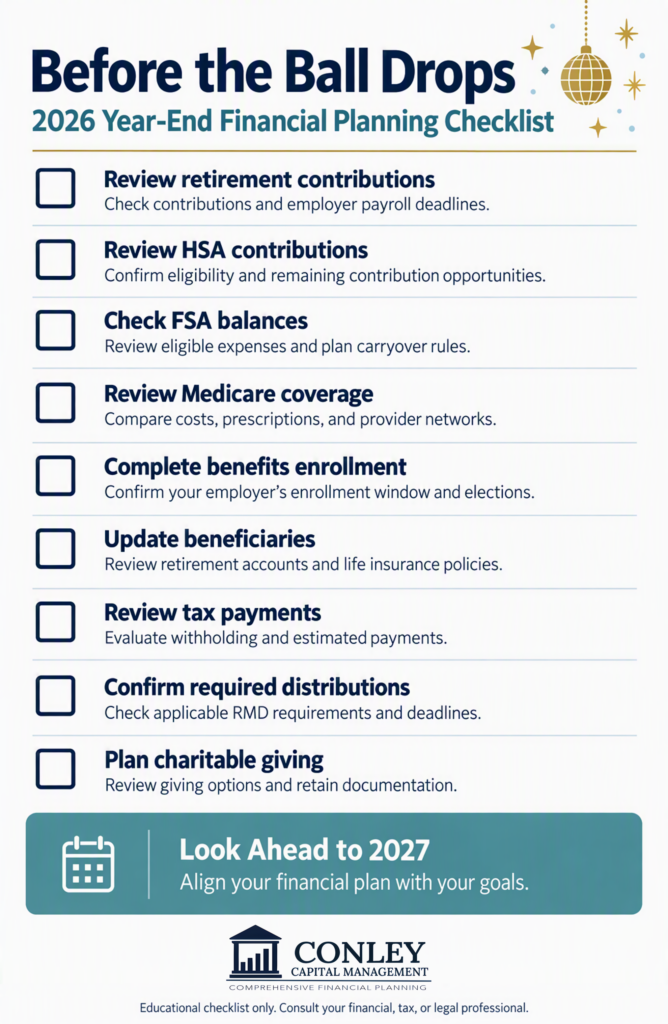
Before the Ball Drops: Your 2026 Year-end Financial Planning Checklist

As 2026 draws to a close, now is a good time to review your financial picture and identify opportunities to strengthen your comprehensive financial plan before 2027. Taking a few proactive steps before the year ends may help reduce potential tax liabilities, maximize savings opportunities, and position you for financial success in the coming year.

Here are several important year-end planning considerations:

Review Retirement Contributions

If you are still working, consider whether you have maximized contributions to an employer-sponsored retirement plan, such as a 401(k) or 403(b). For 2026, the employee contribution limit is $24,500, with additional age-based catch-up contributions available:

  • Ages 50–59: $8,000
  • Ages 60–63: $11,250 Super Catch-Up
  • Ages 64+: $8,000

Restrictions may apply for the type of tax classification of the catch-up contributions (i.e. pre-tax vs Roth) and on the availability of super-catch contributions; consult with the plan administrator to confirm.

Important Deadline: Employee contributions to most employer-sponsored plans generally must be made through payroll by December 31; however, eligible IRA contributions for the 2026 tax year can generally be made until April 15, 2027. Check with your employer on internal deadlines for payroll deduction elections.

Maximize Health Savings Account (HSA) Contributions

If you are enrolled in an eligible high-deductible health plan, an HSA offers valuable tax advantages: tax-deductible contributions, tax-deferred growth, and tax-free withdrawals for qualified medical expenses. It’s important to note that once enrolled in Medicare, whether directly or through automatic enrollment tied to Social Security, you can no longer contribute to an HSA and contributions for that year are generally prorated based on the months before Medicare coverage begins. However, your existing HSA balance remains available throughout retirement for qualified medical expenses, including certain Medicare premiums and other eligible healthcare costs.

For 2026, HSA contribution limits are $4,400 for individual coverage and $8,750 for family coverage, plus a $1,000 catch-up contribution for eligible individuals age 55 and older.

Important Deadline: 2026 HSA contributions can generally be made until April 15, 2027, provided you meet applicable eligibility requirements. If contributing through an employer-sponsored plan, confirm any internal payroll deadlines with your employer to ensure contributions are attributed to 2026 tax year.

Make the Most of Your Flexible Savings Account (FSA)

Like HSAs, FSAs provide a tax-advantaged way to set aside money for qualified healthcare and dependent care expenses. FSA funds can also be used to reimburse yourself for eligible expenses incurred during the plan year, making year-end a good time to review any expenses you may have paid out of pocket. A Health FSA, used for eligible medical, dental, and vision expenses, has a 2026 employee contribution limit of $3,400. A Limited-Purpose FSA, generally designed for dental and vision expenses and often paired with an HSA, also has a $3,400 limit for 2026. A Dependent Care FSA, which can help cover eligible childcare and dependent-care expenses, has a 2026 limit of $7,500 per household, or $3,750 for married individuals filing separately – a notable increase from the $5,000/$2,500 limits in 2025.

Important Deadline: Before end of the year, take a moment to check your FSA balance. Depending on your employer’s plan, unused FSA funds may be forfeited if they aren’t spent by December 31. Review your plan’s eligible expenses and any carryover or grace-period provisions so you can put those tax-advantaged dollars to good use.

Evaluate Medicare Open Enrollment

Medicare open enrollment provides an opportunity to review and change Medicare Advantage, Part D prescription drug, and Medicare supplemental plans for the upcoming year. Because premiums, deductibles, prescription coverage, and provider networks can change, an annual review may identify savings or coverage gaps even if you are satisfied with your current plan. As you evaluate your Medicare options, remember to review your dental and vision policies separately to help ensure that changes to your Medicare coverage do not unintentionally affect these important benefits.

Important Deadline: Medicare open enrollment for 2027 coverage began October 15 and ends December 7. Scheduling with insurance professionals can fill quickly, so reach out sooner rather than later to arrange your review.

Complete Employer-Sponsored Benefits Open Enrollment

If you are still working, use open enrollment to reassess health insurance, HSA and Flexible Spending Account (FSA) elections, life and disability insurance, and other available benefits. Changes in family circumstances, healthcare needs, or financial goals may warrant adjustments.

Important Deadline: Many employers have already started or will soon begin open enrollment, which typically spans a two-week period for making selections. Check with your employer for its specific 2026 enrollment period. If you are unsure which options best align with your financial goals, reach out to CCM for guidance as you make your benefit elections.

Review Beneficiaries During Open Enrollment

Open enrollment is also a good time to review beneficiaries on workplace retirement accounts, group life insurance, and other employer-sponsored benefits. Marriage, divorce, the birth of a child, updating of estate documents, or the passing of a loved one can make existing designations outdated. Also review beneficiaries on IRAs and individual life insurance policies outside your of employer.

Important Reminder: There is no specific deadline, but beneficiary designations generally determine who receives these assets upon your passing – contrary to popular belief, these designations typically supersede instructions in your will. Confirming them helps ensure your assets are distributed according to your wishes and remain aligned with your estate plan.

Evaluate Tax Withholding and Estimated Payments

Review year-to-date income, tax withholding, and estimated payments to determine whether you are on track to meet your 2026 tax obligations, particularly if you had income changes, investment gains, retirement distributions, or other significant financial events.

Important Reminder: Adjustments before year-end may help minimize unexpected tax bills and potential underpayment penalties when filing your return.

Confirm Required Minimum Distributions (RMDs)

If you are subject to required minimum distributions from retirement accounts, confirm that the appropriate amount has been or will be withdrawn before the end of the year – missing an RMD can result in significant IRS penalties. For clients with assets under management, the CCM team automatically reviews accounts to help ensure applicable RMD requirements are satisfied.

Important Deadline: Most annual RMDs must be completed by December 31, although special rules apply to first-year distributions and certain inherited retirement accounts.

Consider Charitable Giving Opportunities

If charitable giving is part of your financial plan, year-end is an opportunity to consider the most tax-efficient way to support organizations important to you. Strategies may include donating appreciated investments, contributing to a donor-advised fund, or making qualified charitable distributions directly from an IRA if eligible.

Historically charitable giving, despite being good for the soul, could only be claimed tax-wise for those who did itemized deductions. Beginning in 2026, eligible taxpayers who claim the standard deduction may also qualify for a limited federal charitable deduction for cash donations. To support any deduction claimed, documentation should be gathered for any cash charitable gifts given throughout the year.

Important Deadline: Most charitable contributions intended for a 2026 tax deduction must be completed by December 31.

Looking Ahead to 2027

Year-end planning is more than checking boxes. It is an opportunity to ensure your financial decisions remain aligned with your broader goals while taking advantage of available tax and savings strategies.

At Conley Capital Management, we continually evaluate opportunities to improve the efficiency of our clients’ financial plans. If your financial circumstances have changed or you would like to discuss any of these year-end considerations, please don’t hesitate to reach out.

A little planning today can make a meaningful difference in the years ahead.

Conley Capital Management offers advisory services through XYPN Sapphire, an SEC- Registered Investment Adviser. The information on this site is educational and is not intended as specific financial, tax, accounting, or legal advice. . Information provided should not be solely relied upon for decision making. Please consult your financial, legal, tax, or accounting professional regarding your specific situation.